
More Than a Voyage: Summer Sea Term Gives Cadets Hands-On Experience Around the World

In July, more than 280 cadets from Cal Poly Maritime Academy returned to California after completing the 2026 Summer Sea Term, a 65-day voyage that covered more than 12,000 miles across the Pacific aboard Training Ship Golden Bear.
Summer Sea Term is Cal Poly Maritime Academy’s signature Learn by Doing experience. For cadets in license-track majors, the annual voyage serves as a floating classroom where knowledge gained in laboratories, simulators and traditional coursework is put into practice while preparing students for careers as licensed maritime officers. Throughout the voyage, cadets stand watch on the bridge, operate engineering systems, maintain the ship, practice emergency response and develop the leadership skills required in the maritime profession.
The 2026 voyage marked the final Summer Sea Term aboard Training Ship Golden Bear, which has served as the academy’s primary training ship for 30 years. As the university prepares for the arrival of the National Security Multi-Mission Vessel Golden State, the voyage represented both the conclusion of a chapter in the academy’s history and a glimpse into the future of maritime education at Cal Poly.
During the voyage, cadets rotated through every aspect of shipboard. Marine Transportation cadets gained experience navigating coastal waters and the open ocean, conducting mooring operations and standing bridge watches. Marine Engineering cadets maintained propulsion and auxiliary systems around the clock, applying classroom instruction to the daily operation of a working vessel.
Life at sea also challenged cadets to develop the teamwork, discipline and adaptability expected of maritime professionals. Long watches, maintenance projects, drills and coursework required students to work together while living in close quarters for more than two months.
Port visits offered cadets opportunities to experience the cultures and communities that shape the global maritime industry. In Papeete, Tahiti, students explored French Polynesia’s waterfront, markets and historic sites while gaining a firsthand appreciation for one of the Pacific’s busiest maritime crossroads. The visit underscored the international nature of the shipping industry and the importance of understanding the communities and cultures connected by the world’s oceans.
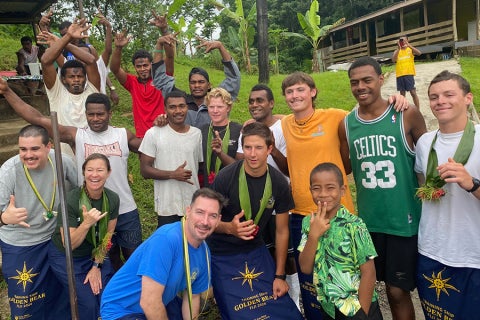
In Fiji, cadets experienced one of the voyage’s most memorable cultural exchanges. After participating in a traditional sevusevu welcoming ceremony, they visited Vuisiga Village, where residents shared customs passed down for generations. Cadets learned traditional mat weaving, sampled food prepared in a lovo earth oven, crossed rivers on bamboo rafts and spent time with village families. These experiences highlighted the importance of cultural awareness and relationship-building in a profession that spans every corner of the globe.
The voyage also introduced many cadets to long-standing maritime traditions. After crossing the equator, students participated in the Golden Shellback ceremony, a centuries-old rite of passage observed by mariners around the world. They also took part in the Sinbad Games, Cal Poly Maritime Academy’s version of the “Olympics at sea,” a friendly competition that builds teamwork, resilience and camaraderie.
Beyond these experiences and traditions, Summer Sea Term remains a critical part of the academy’s educational model. By applying classroom knowledge aboard a working ship while engaging with communities across the Pacific, cadets develop the technical expertise, leadership skills and global perspective needed for careers in commercial shipping, the military, government service and the growing blue economy.
As Golden Bear returned home following its final Summer Sea Term, the voyage marked the end of nearly three decades of service as the academy's training ship. Beginning with the arrival of Golden State, future cadets will continue that tradition aboard one of the nation’s newest and most technologically advanced maritime training vessels, carrying forward Cal Poly’s Learn by Doing approach to maritime education.


