
From Maritime to Mystic: Oceanography Student Takes Learn by Doing Across the Country

For Cal Poly Maritime Academy oceanography major Emma Fiala, the classroom this fall looks a lot different than it did during her first year on the Solano Campus.
Instead of spending the semester entirely on campus, the sophomore international strategy and security and oceanography major is studying oceans and coastal communities in the field, traveling across the country, meeting with maritime professionals, conducting research and exploring the complex connections between science, policy, history and the people who depend on the water.
Fiala is one of a select group of students from across the country participating in the Williams-Mystic Program, an immersive semester-long experience sponsored by Williams College and located in Mystic, Connecticut.
The program combines classroom learning with field seminars, research projects and hands-on experiences designed to give students an interdisciplinary understanding of the world’s oceans and coasts.
It is, in many ways, an extension of the hands-on, interdisciplinary education Fiala is pursuing through Cal Poly Maritime Academy’s Oceanography program on the Solano Campus, only on a much larger map.
“Emma’s experience at Williams-Mystic is a great example of what we want for our Oceanography students,” said Alex Parker, Ph.D., head of Cal Poly Maritime Academy’s Oceanography Department. “We want them to take what they learn here into the field, work alongside scientists, maritime professionals and communities, and see how ocean science can help address real-world challenges. Just as important, Emma will bring those experiences and new perspectives back to our program and the communities we serve.
“The program at Williams-Mystic extends our students strong technical and applied preparation by connecting ocean science to the human dimensions of coasts and oceans, including policy, history, culture, and community resilience,” said Parker, who is also serving as the interim dean of the School of Letters and Sciences. “This is especially valuable for Emma, who is interested in combining ocean science with policy through her dual majors in Oceanography and International Strategy and Security.
“The program is a natural extension of Cal Poly Maritime Academy’s ‘Learn by Doing’ approach. It is immersive, place-based, and grounded in real-world experience. Emma’s participation in the semester program will broaden her professional network and perspectives and help her to develop skills to work collaboratively that are so necessary to be successful in the Blue Economy.”
After driving cross-country with her parents the week before Labor Day, Fiala moved into program-provided housing, met her cohort and began a weeklong orientation to prepare for the semester ahead.
Then, almost immediately, the classroom moved west.
Fiala and her classmates traveled to the Pacific Northwest for the first of two weeklong trips, in addition to a pair of two-day trips offered by the program, where students learn directly from people working across the region's maritime, environmental and coastal communities.
The group heard from maritime, environmental and tribal leaders, including representatives of the Port of Seattle, U.S. Army Corps of Engineers, U.S. Coast Guard and regional tribal organizations.
In all, the students took part in 24 conversations with industry professionals during the trip.
The learning continued in the field, with visits to sites including Puget Sound, Duwamish People’s Park, Ballard Locks, Neah Bay, the Elwha River and Port Townsend.
For Fiala, the trip was also a return to familiar territory.
“I grew up in Spokane, Washington. My dad was a merchant mariner, so we visited the region every single month,” Fiala said. “It was interesting learning about issues taking place in an area where I spent 15 years before moving to North Fork, California.”
What was familiar geographically, however, was anything but familiar academically.
“I was unaware of the challenges the region faced before I took this trip,” Fiala said.
At Duwamish People’s Park, she learned about efforts to restore natural river systems in Seattle and heard from the Port of Seattle’s tribal relations leadership about habitat restoration.
At Ballard Locks, representatives from the Army Corps of Engineers discussed the challenges of managing waterfronts and coastal communities, including balancing the movement of large vessels with the preservation of native salmon populations.
That combination of perspectives is central to Williams-Mystic.
The Pacific Northwest trip is one of three field seminars scheduled throughout the semester, complementing a curriculum that brings together science, humanities, maritime history and policy.
“Literature of the Sea is a humanities requirement, maritime history and marine policy is another, and then there are two options for students to take their science course: marine ecology or oceanographic Processes,” Fiala explained.
Having already completed ecology, Fiala chose oceanographic processes.
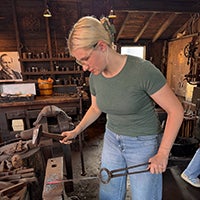
She also selected blacksmithing as her non-credit skills course, one of several options that allow students to learn a practical trade connected to the maritime world. Other options this semester include ship carving and sailing.
“I will spend the whole semester working in a historic forge on the museum grounds, working with an anvil, hammer and hot metal,” Fiala said. “The point of this class is to give students a creative outlet related to coastal studies, or to have a chance to, in our program director's words, use a different part of our brains.”
Perhaps the most distinctive part of the program, however, is what students do with all that exposure.
There are no traditional midterms or finals. Instead, students identify questions that interest them, conduct research and develop individual projects throughout the semester.
For Fiala, one of those projects emerged almost unexpectedly.
During the Pacific Northwest trip, she and her classmates were in the engine room of a Crowley tugboat when a captain began discussing a recent engine-room fire in New Jersey and the challenges firefighters can face responding to fires in confined shipboard spaces.
“We are sitting in the engine room hearing this horrific talk, my marine policy teacher is sitting right next to me, and I ask, ‘Can I write my paper on this?’ And she said, ‘Yeah, of course.’”
Just like that, a conversation became a research project.
“I had a few projects in mind when I arrived that I am really passionate about doing,” Fiala said. “But when we were talking to the tugboat captains, I realized I wanted to explore this.”
The same process is playing out across her other courses.
“For my history project, I came in thinking I knew what I wanted to do. In the first week, I kind of figured out my science project. I have no clue what I want to focus on for my literature project.”
And that, perhaps, is exactly the point.
Williams-Mystic gives students the space to follow questions rather than simply complete assignments.
Outside the classroom and field seminars, students can also work at the nearby Mystic Seaport Museum to help offset the cost of the program. Opportunities include serving as an interpreter, conducting archival research and participating in historic boat restoration.
Fiala was also selected to receive the Thomas B. Crowley Scholarship, which covers her housing and program fees and gives her more time to take advantage of the academic and research opportunities available through the program.
“The museum also provides a 24-hour science and aquarium center,” Fiala said. “There are crabs, conch shells and algae available for research. I am still trying to figure out what I want to focus on with those resources.”
“We hold most of our classes in the main museum, the largest maritime museum in the country,” Fiala said. “This facility provides opportunities to work in its historic shop for our skills classes as part of the American Institute for Maritime Studies, allowing students to conduct research in addition to providing work-study opportunities.”
What began with a recommendation from Parker became an application, a series of interviews and, ultimately, a semester-long opportunity to immerse herself in the maritime world from an entirely different perspective.
Fiala initially viewed the program as an opportunity that would simply strengthen her résumé.
“I originally applied because I thought this would look cool on my résumé,” she said.
But the experience has already become much more than that.
“I am really excited to work on my projects and spend time with my cohort. The social aspect is better than I thought it would be. I never thought I was the kind of person that would do lots of fun stuff in college.”
Living in a house with members of her cohort, sharing responsibilities and building a community has become one of her favorite parts of the experience.
“I enjoy the community aspect of this program where I am living in a house and managing everything with other members of my cohort.”
And when she returns to Cal Poly Maritime Academy for the spring semester, Fiala does not plan to leave the experience behind.
Her hope is to continue developing the projects she begins in Connecticut and connect that work with opportunities closer to home, particularly through the Community Engaged Learning Center's partnerships with organizations such as the Vallejo Flood and Wastewater District.
“My ultimate hope is to take these projects and continue working on them when I return to campus for the spring semester,” Fiala said. “I want to work on something that helps wastewater management districts.”
Then she put the larger purpose of the experience into perspective.
“If I can learn something here and take it back home, perhaps I can continue this work with other community partners as well.”
For a Cal Poly Maritime Academy student, the journey may have taken her across the country.
But the goal remains close to home: learn something real, bring it back and use it to make a difference.


