
More Than a Uniform: Understanding the Cal Poly Maritime Academy Corps of Cadets

Spend a morning on Cal Poly’s Solano Campus and you may see something you will not encounter in San Luis Obispo: students in uniform moving into formation before heading off to class.
They are members of the Cal Poly Maritime Academy Corps of Cadets, a distinctive part of the student experience designed to prepare students for the responsibilities that come with careers at sea and across the maritime industry.
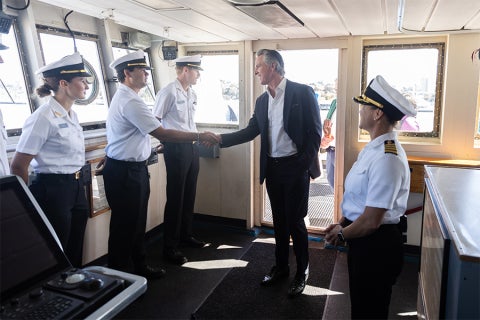
The Corps is not a branch of the military, and participation does not create a military service obligation. Instead, it provides a structured, student-led environment where cadets develop leadership, accountability, teamwork and professional readiness alongside their academic education.
For students pursuing a U.S. Coast Guard license, membership in the Corps is part of their professional preparation. Other students participate because of academic program requirements or choose to join for the leadership experience.
“The uniforms and formations are probably the first things people notice, but those are really just the visible parts of the Corps,” said Lennon Prothro-Jones, director of Cadet Leadership and Development. “The purpose is to develop people who understand responsibility, who can work as part of a team and who are prepared to lead when others are depending on them.”
For students preparing to work aboard commercial vessels, those expectations have a practical purpose.
Life aboard a ship requires more than technical knowledge. Mariners may be responsible for the safety of their shipmates and passengers, standing watch, responding to emergencies, fighting fires, launching survival equipment and performing demanding duties far from immediate shoreside assistance. That responsibility helps explain why physical readiness, including the ability to swim, is part of maritime education.
Incoming students in licensure programs must complete a swim assessment before advancing to more intensive water-based training. The assessment requires students to swim 100 meters (about the length of a football field) without stopping, demonstrating breaststroke, backstroke, sidestroke and a stroke of their choice, followed by a short underwater swim. There are no goggles, except for approved medical needs. The reason is decidedly practical: In an emergency at sea, a mariner isn’t likely to have a pair handy.
Students who do not initially pass receive swimming instruction to develop the skills they need before advancing to marine safety and survival training and, for applicable programs, shipboard training.
The swim assessment is just one example of how requirements that might look unusual in a traditional university setting are connected directly to the responsibilities of the maritime profession.
“On a ship, you have a responsibility to the people around you,” said Jamey Schnasse, Cal Poly Maritime Academy’s 2026-27 Corps commander. “You need to know that the person next to you can do their job, and they need to know the same about you. The Corps starts building that sense of accountability from the moment you arrive.”
Those professional expectations also help explain some of the more visible differences between the Corps experience and student life elsewhere at Cal Poly.
Cadets wear uniforms, participate in formations and take turns standing watch. As they progress, they have opportunities to assume increasing levels of responsibility within the Corps. Cadet leaders help manage day-to-day activities, mentor other cadets and reinforce expectations for professionalism and accountability.
“The Corps gives students an opportunity to practice leadership before someone hands them that responsibility in the workplace,” Prothro-Jones said. “They learn that leadership is not just about being in charge. It’s about being accountable for yourself, taking care of your team and being ready to step up when the situation requires it.”
That experience extends well beyond campus. Aboard the Training Ship Golden Bear and through other hands-on maritime training, cadets put classroom knowledge into practice while living and working as part of a shipboard community. They stand watch, maintain equipment, practice emergency response and learn what it means to be accountable to a team around the clock.
For cadets, that is when some of the structure they encounter on campus begins to make sense.
“You start to understand that there’s a reason behind the expectations,” Schnasse said. “Being on time matters. Paying attention to detail matters. Knowing your responsibilities matters. When you’re aboard a ship, those things can affect everyone around you.”
Not every Corps member will ultimately spend a career at sea. Graduates go on to careers throughout the maritime industry and beyond. But the habits the Corps is designed to develop, including responsibility, resilience, teamwork, leadership and readiness, travel with them. It is another expression of Learn by Doing, shaped by professions where being prepared to step up when others are depending on you isn’t simply encouraged. It’s part of the job.


