
Traversing the Pacific with Celestial Navigation

As we continue our Pacific crossing aboard the Training Ship Golden Bear (TSGB), I’ve had the opportunity to reflect more deeply on one of the most traditional and essential skills in maritime navigation: celestial navigation.
Even in a world dominated by GPS and electronic chart systems, learning how to navigate using the stars, sun and planets remains a critical part of becoming a competent deck officer.
What is a Sextant?
A sextant is a precision instrument used to measure the position of celestial bodies. It works by reflecting a celestial object, such as the sun, stars or planets, through a system of mirrors and a telescope. This allows the user to measure the angle between the celestial body and the horizon. That angle is then used to help determine your position at sea.
Why is the Sextant Still Important Today?
Even with modern GPS technology, the sextant remains extremely important. In the event of a complete systems failure, blackout or GPS malfunction, knowing how to navigate manually becomes critical.
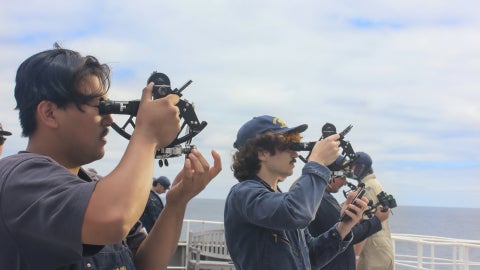
As a future officer, especially as a third mate, I understand the responsibility to determine your position without electronics is not optional. It is a responsibility. Redundancy at sea saves lives.
Celestial Bodies Used in Navigation
In celestial navigation, we primarily use the sun, moon, stars and planets. Each of these celestial bodies follows predictable movements across the sky.
By measuring their altitude at specific times and comparing those readings with calculated data, we can determine a ship’s position on the Earth’s surface. The sun is commonly used during the day, while stars are essential for nighttime fixes, especially during long ocean passages.
The Most Difficult Part of Using a Sextant
For me, the hardest part of learning celestial navigation is not actually holding or using the sextant; it is the precision required in the process. Calculating errors, understanding corrections, and learning the “quirks” of the instrument takes time. The sextant is very sensitive, and even small mistakes in timing or angle measurement can affect accuracy.
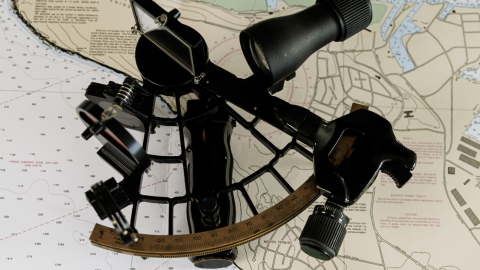
Setting it up correctly and interpreting the readings takes patience, attention to detail, and repetition.
Teamwork in Celestial Navigation
Teamwork plays a major role in making celestial navigation accurate and efficient. When taking a sight, someone must call and record the exact time, down to the seconds, while another person takes the measurement.
This coordination ensures accuracy in calculations later. We rely on each other constantly. Working as a team improves precision and also builds trust, because everyone’s input matters when determining the ship’s position.
Leadership and Learning
As someone who has already taken and passed my U.S. Coast Guard license, I often find myself helping others with celestial calculations and questions.
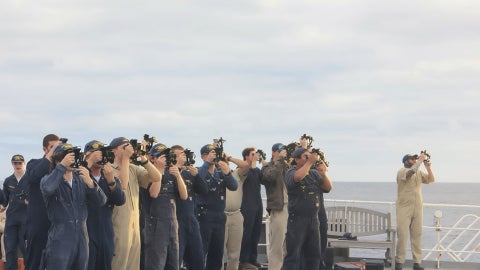
However, what stands out most is that celestial navigation is less about hierarchy and more about fellowship. We are all part of the same ship, working toward the same goal. Leadership in this environment is not just about giving direction, it is about supporting your team and ensuring everyone succeeds together.
Modern Navigation vs Traditional Navigation
Practicing celestial navigation has given me a deeper appreciation for how far maritime technology has evolved. Today’s ships are equipped with advanced GPS, electronic charts, and automated systems that make navigation faster and more efficient than ever before.
However, learning traditional methods gives cadets a stronger, more complete understanding of navigation. It connects us to the foundation of maritime history and reminds us that modern systems were built on centuries of knowledge and skill. We have evolved tremendously in the maritime industry, but that evolution is only meaningful because we understand where we started.
Closing Reflection
Celestial navigation is a skill that every mariner should learn. It teaches discipline, patience, and independence from technology. In my opinion, truly understanding how to navigate without relying on electronic systems is crucial for any officer at sea. We must have a strong foundation in our past in order to improve our present and guide our future.
Fair winds and calm seas…
Check back often and follow the voyage with our series that gives the latest news from Summer Sea Term! TSGB will travel to San Diego, CA; Papeete, Tahiti; Suva, Fiji; Honolulu, HI; and Los Angeles, CA, prior to returning to Vallejo on July 6.


